



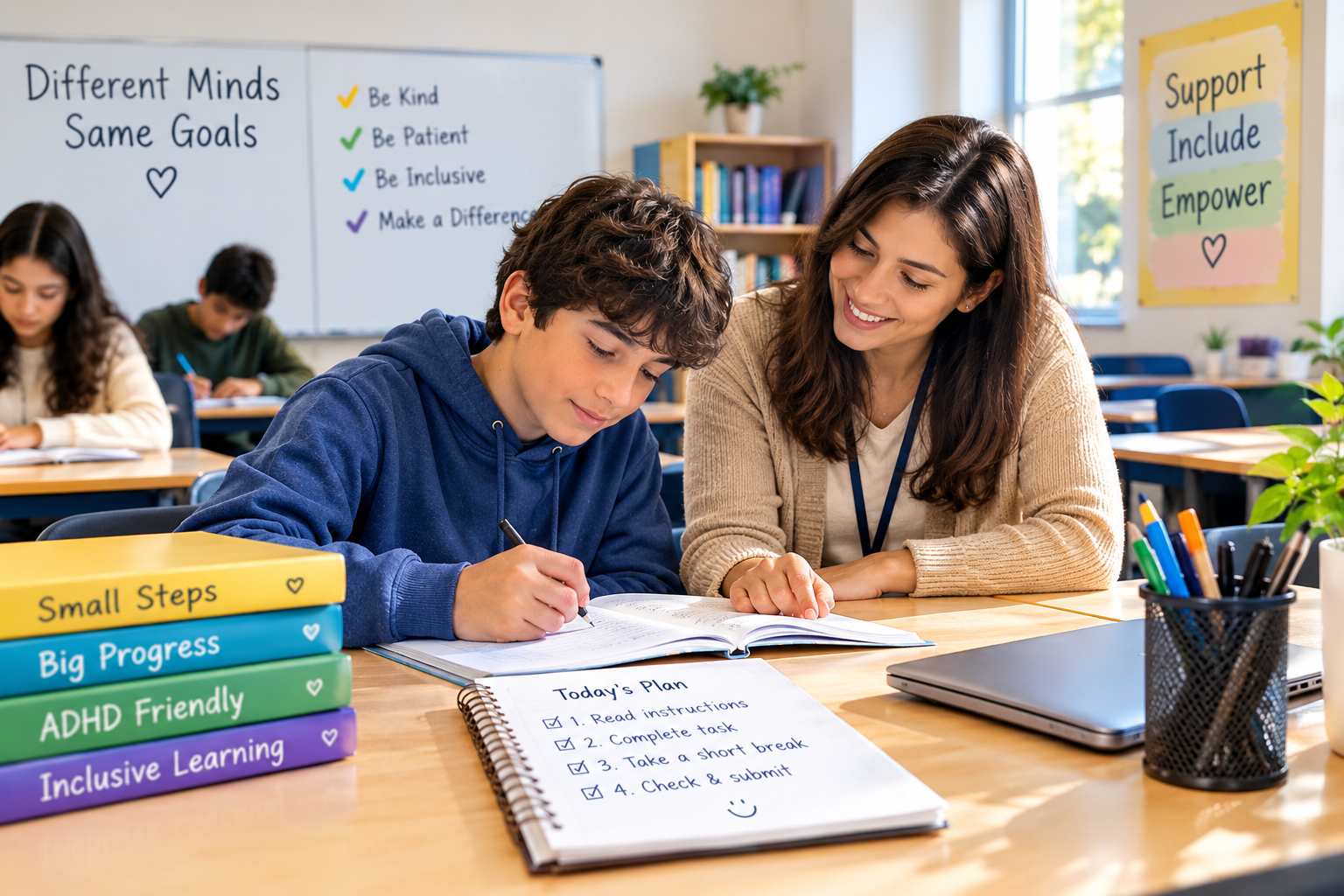
Creating an Inclusive Classroom: Effective Accommodations for Students with ADHD
Introduction: Building Classrooms Where Every Student Can Thrive
Every classroom includes students with different strengths, interests, learning preferences, and support needs. Some students concentrate best in quiet environments, while others benefit from movement, frequent feedback, or activities broken into smaller steps.
For students with attention-deficit/hyperactivity disorder (ADHD), ordinary classroom demands such as remaining seated, organizing materials, remembering instructions, or completing lengthy assignments can sometimes create additional challenges.
ADHD is a neurodevelopmental condition associated with patterns of inattention and/or hyperactivity and impulsivity. Its effects vary from student to student. Some students may struggle with organization and sustained attention, while others may find waiting, managing impulses, or regulating activity particularly difficult.
The goal of an inclusive classroom is not to make every student learn in exactly the same way. It is to remove unnecessary barriers while maintaining meaningful learning expectations.
In this guide, TeacherForum.org explores practical ADHD accommodations teachers can use to support student participation, independence, confidence, and academic progress.
1. Understand ADHD and Each Student's Individual Needs
Effective support begins with understanding the student rather than making assumptions based on a diagnosis.
Two students with ADHD may have very different experiences. One might need help organizing written assignments, while another might benefit from opportunities to move during lessons. Some students may perform well academically but struggle to submit work consistently.
Teachers should observe patterns, identify barriers, and work collaboratively with students, families, and relevant school professionals.
Recognize Common Classroom Challenges
Students with ADHD may experience difficulties with:
- Sustaining attention during lengthy explanations.
- Remembering multistep instructions.
- Organizing books, assignments, and materials.
- Beginning tasks independently.
- Managing transitions between activities.
- Waiting for turns or responding impulsively.
- Estimating how long assignments will take.
- Monitoring progress and completing work.
These challenges should not automatically be interpreted as laziness, disrespect, or a lack of motivation.
A student who forgets to submit an assignment may need a clearer organizational system. A student who interrupts may benefit from structured participation routines and discreet reminders.
Practical example: If a student repeatedly forgets homework, introduce a consistent end-of-lesson checklist and a designated place to record assignments before assuming that additional punishment will solve the problem.
2. Create a Predictable and Organized Classroom Environment
Predictability reduces uncertainty and helps students understand what they should do next.
A well-organized classroom benefits the entire class, including students who experience difficulties with attention, transitions, or executive functioning.
Establish Consistent Routines
Display a daily schedule and explain any changes in advance whenever possible. Begin lessons with a familiar routine, such as reviewing the learning objective, preparing materials, and completing a short starter activity.
Use clear visual reminders for common classroom procedures.
For example, a classroom checklist might read:
- Take out your notebook.
- Write the date and learning objective.
- Complete the starter activity.
- Check the instructions before beginning the main task.
Reduce Unnecessary Distractions
Consider where students sit, the amount of visual clutter around important learning areas, and how classroom materials are arranged.
Some students benefit from sitting near the teacher or away from busy walkways. Others may work better in a quieter area for independent activities.
Avoid assuming that the front row is always the best location. Ask the student what helps and monitor whether the arrangement improves participation.
Important: Seating adjustments should be supportive rather than punitive. A student should not be publicly singled out or isolated because of ADHD.
3. Break Assignments Into Smaller, Manageable Steps
Large assignments can feel overwhelming when students must plan, organize, begin, and monitor several tasks at once.
Breaking work into smaller sections makes expectations more visible and gives teachers opportunities to check understanding before difficulties build up.
Use Task Chunking
Instead of asking students to complete a full worksheet independently, divide it into short sections with clear instructions.
For example, a writing assignment could be divided into:
- Step 1: Choose a topic.
- Step 2: Write three main ideas.
- Step 3: Develop an outline.
- Step 4: Draft the introduction.
- Step 5: Complete the first paragraph.
- Step 6: Review and revise the work.
Provide feedback at suitable checkpoints rather than waiting until the entire assignment is finished.
Make Instructions Concrete
Avoid delivering long lists of instructions verbally and expecting every student to remember them.
Combine concise spoken directions with written instructions, examples, or visual checklists.
A useful approach is to give two or three steps at a time, ask the student to explain the first step, and then check progress.
Practical example: During a science activity, display the equipment list, numbered procedure, and expected outcome. Students can refer to the instructions independently rather than repeatedly trying to remember what comes next.
4. Incorporate Movement and Appropriate Activity Breaks
Some students with ADHD find it difficult to remain still for long periods. Opportunities for purposeful movement may help them re-engage with classroom activities.
Movement should be treated as one possible support, not as a universal requirement for every student with ADHD.
Offer Structured Movement Opportunities
Teachers can consider:
- Brief movement breaks between demanding tasks.
- Classroom jobs, such as distributing materials.
- Short standing activities when appropriate.
- Learning stations that involve moving between tasks.
- Stretching breaks during longer lessons.
Plan movement opportunities so they are predictable and do not interfere with safety or other students' learning.
Use Active Learning Strategies
Where appropriate, combine movement with academic content.
For example, in a vocabulary lesson, students might move to different classroom areas representing possible answers. In mathematics, they could use floor number lines to explore numerical relationships.
These activities can increase participation while giving students different ways to demonstrate understanding.
Avoid using movement breaks as rewards that students must earn after prolonged periods of struggling to remain still. Instead, consider whether movement can be built naturally into the learning environment.
5. Use Positive and Proactive Classroom Management
Students are more likely to develop self-regulation skills when expectations are clear and teachers respond consistently and respectfully.
Public criticism, sarcasm, repeated reprimands, and unpredictable consequences can damage trust and distract students from learning.
Establish Clear Expectations
Create a small set of positively worded classroom expectations, such as:
- Listen when someone else is speaking.
- Use materials safely.
- Ask for help when you need it.
- Give others space to learn.
- Return to the task after a reminder.
Teach and practise these expectations instead of assuming students already know how to apply them in every situation.
Reinforce Desired Behaviors
Notice specific actions and describe them clearly.
Instead of saying, "Good job," a teacher might say, "You checked the instructions, organized your materials, and started the first question independently."
This feedback shows the student exactly which behaviors supported success.
For students who benefit from additional structure, teachers can agree on one or two achievable goals and review progress privately.
Practical example: A student who frequently calls out might use a discreet visual reminder to pause and raise a hand. The teacher can acknowledge successful participation without drawing unnecessary attention to the student's difficulties.
Behavior support should teach useful skills and preserve dignity. It should not rely on shame or punishment for symptoms the student may find difficult to control.
6. Adapt Assessment and Classroom Tasks Fairly
Inclusive teaching does not mean removing learning objectives. It means considering whether the way a student is expected to demonstrate learning creates an unnecessary barrier.
A student may understand a concept but struggle to show that understanding under particular timing, organizational, or task-format demands.
Consider Flexible Ways to Demonstrate Learning
Depending on the learning objective and applicable school policies, useful adjustments may include:
- Dividing a long assessment into sections.
- Providing written directions alongside verbal instructions.
- Allowing brief movement breaks during longer assessments.
- Using interim deadlines for larger assignments.
- Offering an appropriate alternative response format when the objective permits it.
- Providing additional time when justified and authorized.
For example, if the objective is to assess understanding of a historical event, a student might demonstrate learning through a structured written response or an approved oral presentation.
However, if the assessment specifically measures extended writing, changing the response format may alter what is being assessed. Teachers should distinguish between removing irrelevant barriers and changing essential learning requirements.
Provide Feedback Early
Frequent, focused feedback helps students identify errors and make adjustments before an assignment becomes unmanageable.
Rather than marking every issue at once, identify the most important next step. For example, a student writing an essay might first receive feedback on organizing the main argument before working on sentence-level editing.
Follow school assessment policies and any formal accommodation plans.
7. Support Executive Functioning and Organization
Executive functioning includes skills used to plan, organize, remember instructions, manage time, and monitor progress. Some students with ADHD may need explicit support in these areas.
Teachers can help students build these skills through repeated routines and practical tools.
Introduce Simple Organizational Systems
Useful strategies include:
- Color-coded folders for different subjects.
- A single homework planner or approved digital task list.
- A checklist for packing school materials.
- Clearly labelled storage areas.
- Visual timers for activities with defined time limits.
- Calendar reminders for assignments and upcoming assessments.
Choose systems that are simple enough to use consistently. Too many planners, apps, or checklists can become another source of confusion.
Teach Time Management Explicitly
Help students estimate how long a task may take, identify a starting point, and check progress.
For example, a 30-minute assignment might include five minutes for planning, 15 minutes for completing the main task, five minutes for checking answers, and five minutes for submitting the work.
These times should be adjusted to the activity and the student's needs rather than applied rigidly.
Practical example: Before a project begins, work with the student to create a mini-calendar showing when the topic, outline, draft, and final submission are due.
The purpose is to gradually build independence, not to make students permanently dependent on adult reminders.
8. Collaborate With Families and School Support Teams
Teachers do not need to solve every challenge independently. Collaboration can help create consistent, realistic support across the student's school experience.
Families may understand which routines work at home, while school specialists can help identify appropriate strategies and formal accommodations.
Communicate Constructively With Families
Begin conversations with specific observations and a shared goal.
Instead of saying, "Your child never pays attention," explain what happened and explore possible solutions.
For example:
"I have noticed that beginning independent writing tasks is difficult, even when the student can explain the topic verbally. We are trying a short planning checklist and checking the first step together. Have you found any routines that help with starting tasks?"
This approach avoids blame and invites collaboration.
Coordinate Support at School
Where appropriate, work with special education professionals, school counselors, learning support staff, and other relevant personnel.
Follow applicable privacy requirements and share student information only with authorized individuals for legitimate educational purposes.
Teachers should follow formal accommodation plans and school procedures. They should not independently diagnose ADHD, recommend changes to prescribed medication, or promise that a particular strategy will work for every student.
9. Protect Student Confidence and Belonging
Academic progress is only one part of an inclusive learning environment. Students also need to feel respected, capable, and connected to their classroom community.
Repeated negative feedback can lead students to view themselves as unsuccessful, especially when their difficulties are misunderstood.
Avoid Public Labels and Comparisons
Do not discuss a student's diagnosis in front of classmates without appropriate authorization and a clear educational reason. Avoid statements that compare the student's behavior unfavorably with that of peers.
Provide reminders discreetly whenever possible, and recognize strengths alongside areas requiring support.
Give Students a Voice in Their Support
When developmentally appropriate, ask students questions such as:
- Which classroom activities help you concentrate?
- What makes it difficult to start an assignment?
- Would written instructions or a checklist be useful?
- What kind of reminder feels helpful rather than distracting?
Student input can help teachers choose strategies that are practical and respectful.
An inclusive classroom recognizes that students can develop self-awareness and self-advocacy over time.
10. Review Accommodations and Measure Progress
An accommodation should be reviewed to determine whether it is actually helping the student participate and learn.
Avoid relying on assumptions or continuing a strategy simply because it is commonly recommended.
Monitor a Small Number of Meaningful Indicators
Depending on the student's goals, teachers might track:
- Whether the student begins tasks more independently.
- The frequency of completed assignments.
- Accuracy on relevant learning tasks.
- Participation in classroom activities.
- Successful transitions between lessons.
- The student's own feedback about concentration and confidence.
Keep records proportionate, confidential, and consistent with school policy.
Review the information with the student and relevant support team. If an approach is ineffective, consider changing the strategy rather than blaming the student.
Progress may be gradual and can vary across subjects, environments, and days.
Actionable Takeaways: A Simple Plan for Teachers
You do not need to introduce every accommodation at once. Start with a manageable plan and build on what works.
This week:
- Identify one classroom barrier that appears to affect the student's learning.
- Ask the student, where appropriate, what makes the task difficult.
- Introduce one practical support, such as written instructions, task chunking, or a visual checklist.
- Explain expectations and practise the new routine.
- Observe whether the strategy improves participation or task completion.
- Discuss relevant observations with authorized colleagues or the family when appropriate.
- Review and adjust the support based on evidence and the student's feedback.
Quick classroom checklist
- Classroom routines and expectations are clear.
- Instructions are available in a form the student can revisit.
- Longer assignments are divided into manageable steps.
- Appropriate movement and regulation opportunities are available.
- Positive, specific feedback is used.
- Organizational tools are simple and consistent.
- Assessment arrangements follow the student's needs and applicable plans.
- Student privacy and dignity are protected.
- Accommodations are reviewed for effectiveness.
Frequently Asked Questions About ADHD Accommodations
1. What are the most effective classroom accommodations for students with ADHD?
Helpful options may include predictable routines, concise written instructions, task chunking, organizational checklists, planned movement breaks, positive feedback, and appropriate assessment adjustments. The most effective combination depends on the individual student and should be reviewed over time.
2. How can teachers help students with ADHD stay focused?
Make instructions clear, reduce unnecessary distractions, divide lengthy activities into smaller steps, and check understanding before independent work begins. Some students may also benefit from movement opportunities, visual reminders, and brief progress check-ins.
3. Should students with ADHD receive extra time on assignments?
Additional time may be appropriate when it addresses a student's documented needs and aligns with school policies or an accommodation plan. It is not automatically necessary for every student with ADHD. Teachers should consider the task, the learning objective, and the student's individual circumstances.
4. How can teachers manage impulsive behavior in the classroom?
Teach clear participation routines, use calm and consistent reminders, reinforce desired behaviors, and provide discreet prompts when needed. Consider whether environmental factors or unclear expectations contribute to the behavior. Avoid humiliating students or assuming every interruption is deliberate misconduct.
5. Can classroom accommodations help other students too?
Yes. Clear routines, visual schedules, concise instructions, structured feedback, and organized learning activities can benefit many students. Universal classroom supports can improve access for the whole class, while individualized accommodations address specific needs.
6. Should teachers tell classmates that a student has ADHD?
Teachers should respect the student's privacy and follow school policies and applicable laws. A diagnosis should not be disclosed casually. General classroom discussions about different learning needs may promote understanding without identifying an individual student's private information.
7. Do teachers need to diagnose ADHD before providing support?
No. Teachers should not diagnose ADHD. They can use appropriate classroom strategies, document educational observations, communicate with authorized support staff, and follow school procedures when a student may need additional assessment or formal accommodations.
Conclusion: Inclusion Begins With Understanding
Creating an inclusive classroom for students with ADHD is not about lowering expectations or finding one perfect strategy. It is about identifying barriers, providing appropriate support, and helping students develop the skills they need to participate more independently.
Predictable routines, manageable assignments, purposeful movement, positive classroom management, organizational tools, and respectful collaboration can make everyday learning more accessible.
Most importantly, teachers should remember that ADHD does not define a student's abilities, interests, or potential. Each student deserves an opportunity to learn in an environment where individual needs are taken seriously and strengths are recognized.
Start with one practical adjustment, observe its impact, and refine your approach as you learn more about the student.
At TeacherForum.org, educators can share classroom experiences, exchange inclusive teaching strategies, and learn from colleagues who are working toward the same goal: helping every learner feel supported, respected, and ready to succeed.
