

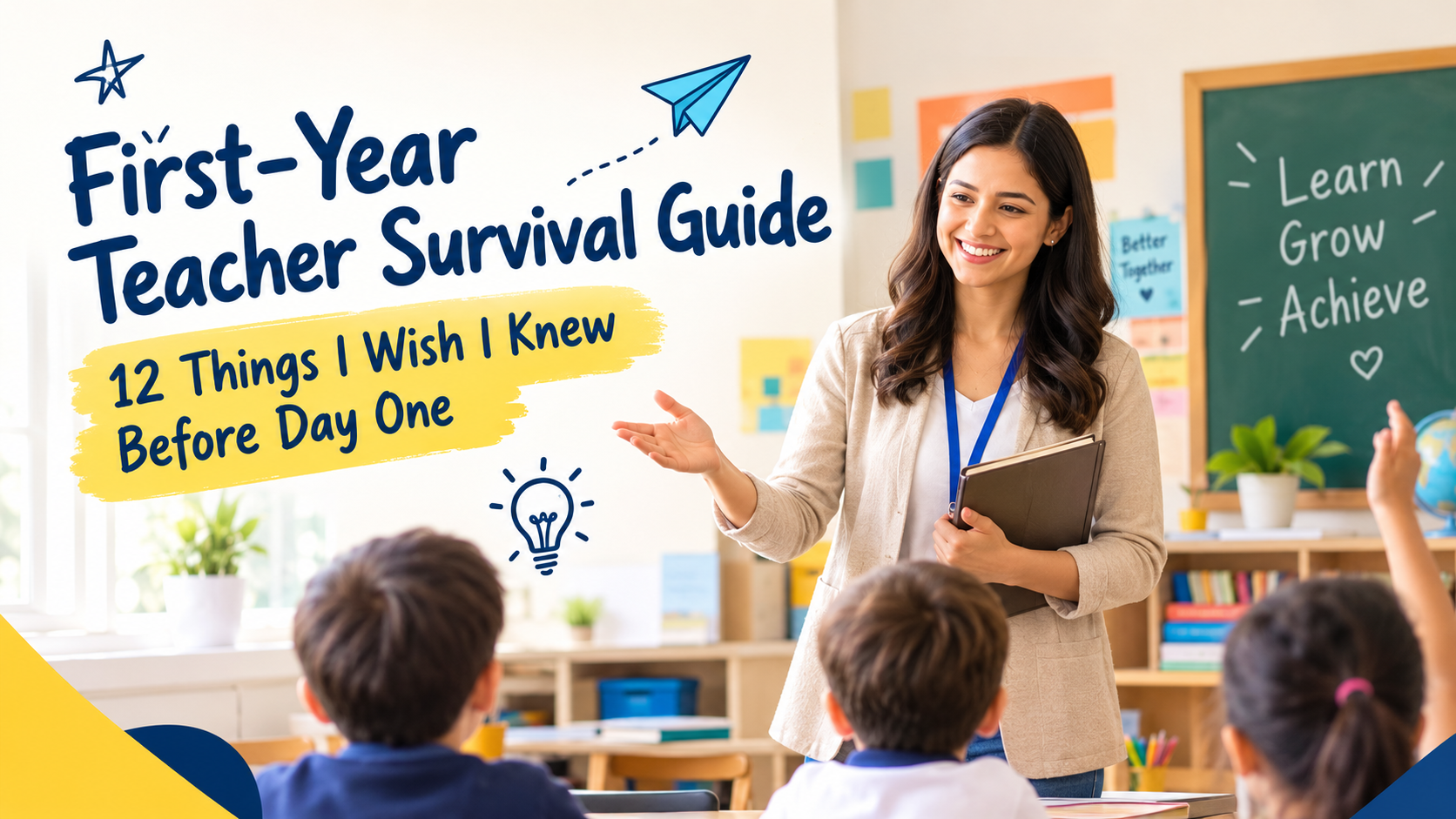
First-Year Teacher Survival Guide: 12 Things I Wish I Knew Before Day One
Your first day as a teacher may come with a carefully arranged classroom, a fresh lesson plan, and a head full of hopes—and nerves. You want students to feel welcome, lessons to run smoothly, and every child to learn. But real classrooms rarely follow a perfect script. The projector may not work, an activity may take twice as long as expected, and the questions you prepared may not reveal what students actually understand.
That is normal. Teaching is a skill built through practice, reflection, support, and small adjustments. You do not need to know everything before day one, and you do not need to prove yourself by working every evening. This first-year teacher survival guide shares 12 practical lessons that can help new teachers build steady routines, connect with students, manage their workload, and grow in confidence.
Think of these tips as a starting point, not a rigid formula. Adapt them to your school’s policies, your students’ ages and needs, and the advice of trusted colleagues.
1. Build Relationships Before You Expect Perfect Behaviour
Students are more likely to engage when they feel seen, respected, and safe. Relationships do not require you to be every student’s friend; they require consistency, curiosity, and fairness.
What to do before and during the first week
Learn names as quickly as you can, greet students at the door when practical, and make time for low-pressure conversations. Notice interests, strengths, and the ways students prefer to participate. Use students’ names respectfully and follow up when someone shares something important.
Pair warmth with clear boundaries. Explain what respectful discussion looks and sounds like, and respond calmly when expectations are missed. A relationship grows when students can trust both your care and your consistency.
2. Teach Routines Explicitly—Do Not Assume Students Know Them
A routine is a procedure students can practise until it becomes familiar. It reduces repeated instructions and gives the class more time for learning. Even older students benefit from clear procedures when they enter a new classroom.
Choose a few high-impact routines
Plan how students will enter the room, begin a task, ask for help, move between activities, submit work, use classroom materials, and pack up. Demonstrate each routine, let students practise it, and reteach it when necessary.
Post concise reminders where students can see them. Rather than repeating “You know what to do,” calmly explain or model the next step. Early practice may feel slow, but it can save time throughout the year.
3. Plan the Learning Goal, Not Every Minute
Detailed lesson plans can be reassuring, especially at first. However, trying to script every minute can make it difficult to respond when students need more explanation or move ahead faster than expected.
Use a simple lesson structure
Identify one clear learning goal, a short way to introduce or model it, a guided practice activity, an opportunity for students to work or explain independently, and a quick check for understanding. Prepare one extension task and one support option when possible.
Keep a small buffer for questions, transitions, and technical problems. If a lesson runs short, use a review question or reflection prompt. If it runs long, prioritise the learning goal rather than rushing through every planned slide.
4. Have a Backup Plan for Technology and Activities
Digital tools can fail, links may be blocked, and materials can go missing. A backup plan helps you stay calm instead of losing the whole lesson.
Prepare a low-tech alternative
For every activity that depends on a device, video, website, or presentation, ask yourself: “Could students still practise the same skill without this?” Keep a short printed task, discussion prompt, worked example, or board activity ready.
Check equipment and links before class when possible, but remember that preparation cannot prevent every problem. If something fails, explain the change briefly and move to the alternative.
5. Make Classroom Expectations Clear, Fair, and Consistent
Classroom management is not about controlling every moment. It is about creating conditions where students can learn, mistakes can be addressed, and everyone knows what to expect.
State expectations positively
Use clear, observable language such as “Listen while someone is speaking” or “Begin the warm-up when you sit down.” Explain the reason behind important expectations and apply school behaviour policies consistently.
Correct behaviour without humiliating students. Whenever possible, address a concern quietly, describe the behaviour rather than labelling the child, and give a clear next step. If a situation is serious or recurring, document relevant facts and follow school procedures.
6. Check Understanding Before Moving On
A quiet room does not always mean students understand. Some may be confused, reluctant to ask questions, or following a peer’s answer. Brief formative checks reveal what needs attention before misconceptions become harder to fix.
Try quick, low-marking checks
Ask every student to answer one focused question on a mini whiteboard, respond to a short exit ticket, explain a step to a partner, or sketch a concept. Look for patterns rather than grading every response.
Use the evidence to decide what comes next: reteach a point, give a second example, form a short support group, or offer an extension. Students learn that assessment is part of learning—not just a score at the end.
7. Ask for Help Early—and Be Specific
You are not expected to solve every challenge alone. Experienced teachers can often share practical solutions, school-specific guidance, templates, and insights that are difficult to learn from a handbook.
Make it easy for colleagues to help
Instead of saying only “I’m struggling,” describe the situation and what you have tried: “Students are taking ten minutes to start independent work. Could you show me how you teach that transition?” Ask about school procedures, safeguarding expectations, communication channels, and where to find approved resources.
Identify a mentor or trusted colleague if your school offers one. You can also ask a department lead or administrator when a question involves policy or student safety. Seeking help is professional judgement, not failure.
8. Keep Parent and Caregiver Communication Clear
Positive, respectful communication with families can build trust before a concern arises. Follow your school’s communication policy, use approved channels, and avoid promising confidentiality or outcomes you cannot guarantee.
Start with clarity and partnership
When sharing a concern, describe specific observations, explain how they affect learning, and invite the family’s perspective. For example: “I’ve noticed that the last three assignments have not been submitted. Is there anything that might help us support completion?”
Keep messages factual and professional, especially when emotions are high. For complex issues, arrange a conversation through the appropriate school process and document key follow-up steps as required.
9. Do Not Grade Everything
New teachers often feel that every task must be marked in detail to prove that learning matters. But extensive marking can consume evenings and weekends without always giving students feedback they can use.
Choose the right level of feedback
Decide which assignments need detailed comments, which can be checked against a short rubric, and which can be reviewed through self-assessment, peer feedback, or a whole-class discussion. Give students one or two specific next steps instead of correcting every small issue.
Use quick checks during lessons to catch confusion early. A focused comment such as “Add evidence to support your claim” is often more actionable than a long paragraph of corrections.
10. Protect Your Time and Energy
Teaching matters, but constant exhaustion is not a sustainable measure of commitment. You will have more capacity to support students when you protect time for rest and plan your workload realistically.
Create a workable weekly routine
Batch similar tasks, reuse and improve effective materials, and set a reasonable time to stop working on most days. Prioritise tasks by urgency and impact rather than trying to make every resource perfect. Use school-approved planning tools and shared resources when available.
Leave space for meals, sleep, movement, relationships, and interests outside school. If stress feels persistent or begins to affect your health or ability to function, speak with a trusted person or an appropriate professional support service.
11. Expect Lessons to Go Wrong—and Reflect Without Self-Blame
Not every activity will work. A discussion may stall, instructions may be unclear, or students may need more background knowledge than you expected. One difficult lesson is information, not a verdict on your ability.
Use a short reflection
After a lesson, write down three things: what helped students learn, where they became stuck, and one adjustment for next time. If a lesson went poorly, look for a specific factor you can change—such as modelling the task, shortening instructions, or adding practice.
Avoid trying to fix ten things at once. Choose one manageable improvement, test it, and notice whether it helps. Over time, these small cycles of reflection build stronger teaching judgement.
12. Celebrate Small Wins and Track Your Growth
The first year can feel like a long list of things you have not mastered yet. Make room to notice progress: a student who participates for the first time, a transition that becomes smoother, or a lesson where students explain an idea independently.
Keep a simple evidence-of-growth note
At the end of each week, record one success, one question, and one goal for the following week. Save useful lesson materials and note what you would change before using them again. When appropriate, collect evidence of student progress while following school privacy and recordkeeping rules.
Your goal is not to become a perfect teacher in one year. It is to become a more observant, prepared, and responsive teacher who knows how to keep learning.
A Quick First-Week Checklist
- Learn the school’s key policies, emergency procedures, and student-support pathways.
- Teach and practise entry, transition, help-seeking, and end-of-class routines.
- Share clear learning goals and explain how students can ask for help.
- Prepare one low-tech backup activity for technology-dependent lessons.
- Choose a simple way to check understanding each day.
- Identify a colleague or mentor you can approach with questions.
- Set a realistic end-of-day stopping point and protect time to recharge.
Frequently Asked Questions
What should a first-year teacher focus on first?
Start with relationships, clear routines, manageable lesson goals, and student safety. You can refine classroom displays and teaching resources over time; students benefit most from a predictable, respectful environment and clear learning.
How can new teachers manage a classroom without being too strict?
Be warm and consistent. Teach expectations explicitly, reinforce appropriate behaviour, respond calmly to problems, and follow school policy. Clear boundaries and respectful relationships support one another.
How much time should a first-year teacher spend lesson planning?
There is no single ideal number of hours. Begin with the required curriculum and learning goal, reuse effective structures, and plan enough to teach clearly while leaving room to adapt. Ask your mentor or school leader about local expectations.
What should a new teacher do when a lesson fails?
Stay calm, protect student safety, and make a practical adjustment if needed. After class, identify what did not work and why, ask a colleague for input if useful, and change one element for the next attempt. A difficult lesson is a chance to learn.
How can first-year teachers avoid burnout?
Set reasonable work boundaries, prioritise high-impact tasks, reuse materials, ask for support, and protect sleep and time outside school. If stress becomes persistent or overwhelming, seek support through trusted colleagues, school resources, or an appropriate professional.
Conclusion
Your first year of teaching will include rewarding moments, unexpected challenges, and plenty of learning. You do not have to get everything right on day one. Build relationships, teach routines, plan around clear learning goals, check understanding, and ask for support when you need it. Protect your energy and reflect on one improvement at a time. With practice and a supportive professional network, the classroom will become more familiar—and your confidence can grow alongside your students.
